
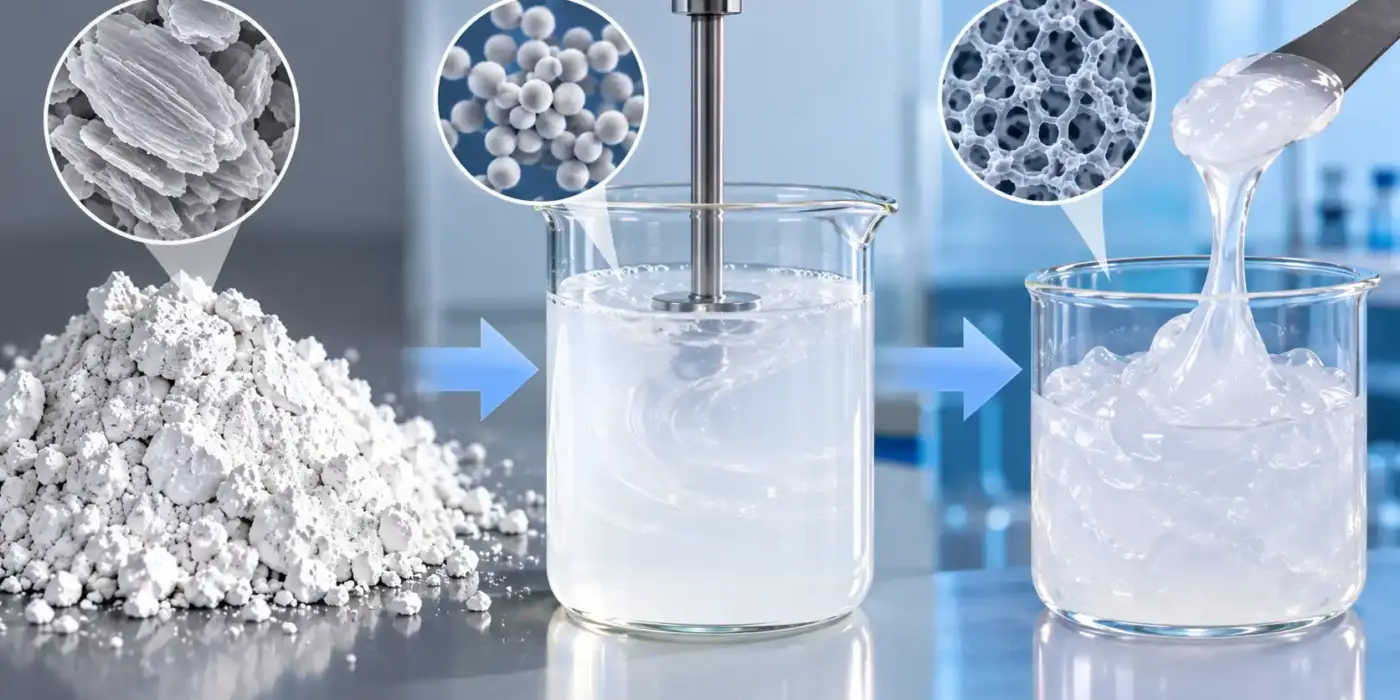
Pseudo boehmite is often selected by Al₂O₃ content, BET surface area and pore volume. For catalyst binders and shaped alumina carriers, however, these values do not fully describe how the material will behave after acid is added.
Two pseudo boehmite grades can have similar chemical purity and surface area while showing different acid demand, pH response and gel development. One may disperse quickly and form a strong binder with a relatively low acid dosage, while another may require more acid or produce a different slurry consistency.
At Detopalu, we treat peptization as part of grade behaviour, not as a separate laboratory number. The required material depends on how the pseudo boehmite is expected to perform in the customer’s catalyst or alumina system.
Table of Contents
What Peptization Tells Us About a Pseudo Boehmite Grade
Pseudo boehmite has a hydroxyl-rich surface that can respond strongly to acidic conditions. When a suitable acid is added, particle interactions change and the material can form a more dispersed, colloidal structure.
For catalyst applications, this behaviour is important because pseudo boehmite is often expected to act as both an alumina precursor and a binder.
A grade with good peptization response can develop the cohesion needed for shaping while maintaining the pore and surface properties required after calcination. A grade with weaker peptization may still be suitable for another application where binding strength is less important and pore structure or particle characteristics have greater priority.
This is why Detopalu does not describe one pseudo boehmite as universally “better” simply because it has a higher gelation value.
The right grade depends on the required function.
Acid Demand Varies Between Pseudo Boehmite Grades
Acid demand describes how much acid is required to produce the desired peptization response under a defined test condition.
This value can change with the physical structure of the pseudo boehmite. Surface area, crystallinity, pore structure, particle aggregation and manufacturing route can all influence how the powder reacts with acid.
A more readily peptizable grade may achieve the required dispersion or gel behaviour using less acid. Another grade may need a higher dosage to reach a similar state.
For customers using pseudo boehmite as a catalyst binder, this difference matters because a change in acid demand can affect formulation consistency and production stability.
Detopalu therefore looks at acid response together with the other grade parameters rather than treating it as a standalone specification.
A typical comparison may involve:
| Property | Why it matters |
|---|---|
| BET surface area | Indicates available surface and precursor characteristics |
| Pore volume | Helps define the target porous structure |
| Gelation / peptization | Indicates acid response and binder behaviour |
| Dry basis / LOI | Affects calculation of actual active material |
| Particle characteristics | Influence dispersion and handling |
| Na, Fe, Si, sulfate or other residues | May affect downstream catalyst performance |
pH Is Part of the Response, Not the Whole Specification
pH is commonly used during pseudo boehmite peptization because it provides a simple way to track how the slurry responds to acid.
However, the same pH does not necessarily mean that two pseudo boehmite grades have reached the same condition.
A material with higher surface area or different surface chemistry may consume more acid before reaching the same measured pH. Differences in impurities and dry basis can also influence the response.
For this reason, Detopalu does not recommend judging pseudo boehmite performance from a target pH alone.
A more useful comparison considers:
acid dosage + pH response + gelation behaviour
together.
If a customer already uses a stable pseudo boehmite grade, the existing acid dosage and pH range provide useful reference data when we match another Detopalu grade.
Gel Strength Should Match the Application
High gel strength sounds desirable, but maximum gelation is not required in every pseudo boehmite application.
For catalyst extrusion, sufficient gel development can help provide cohesion and shape retention. In another system, too much gel development may create unnecessary viscosity or make the formulation harder to process.
Some applications need strong binder behaviour. Others place more emphasis on pore volume, surface area or final calcined structure.
This is reflected in the Detopalu Pseudo Boehmite Powder range, where different grades have different gelation characteristics.
Microporous catalyst binder grades may require stronger peptization performance, while macroporous products can be designed around a different balance of pore structure and gel behaviour. A lower gelation index therefore does not automatically indicate lower product quality.
Why BET and Gelation Should Be Considered Together
BET surface area is one of the most commonly requested pseudo boehmite parameters, especially for catalyst and adsorbent applications.
It should not be separated from peptization behaviour.
A high-surface-area material exposes more surface to the liquid phase and can respond differently to acid than a lower-BET grade. This can affect acid demand and slurry behaviour.
Likewise, two materials with similar BET values can still show different gelation if their crystallinity, pore structure or particle aggregation is different.
At Detopalu, grade matching therefore begins with the combination of:
BET, pore volume, gelation, impurity control and end application.
This is more reliable than selecting the highest available BET value. For catalyst applications, the Pseudo Boehmite for Catalyst Carriers page explains how these properties work together in alumina carrier and binder systems.
The Acid Type Also Affects the Result
Pseudo boehmite can be peptized with different acids, including nitric acid, hydrochloric acid and some organic acids.
These acids should not be treated as identical simply because they all reduce pH.
Different acids introduce different anions and can produce different colloidal and rheological responses. The acid system may also need to remain compatible with other catalyst components.
Gelation Index Needs a Defined Test Method
“Gelation index”, “peptization index” and “peptizability” may use different acids, solid concentrations, reaction times or calculation methods depending on the supplier or laboratory.
A number such as 90% or 95% therefore has value only when the test method is understood.
Detopalu’s published grade data should be used as a first selection reference. For applications where peptization is critical, the final match should be based on the customer’s own requirement or sample test.
This is particularly important when the customer is replacing an existing grade.
If the current material already performs well, its specification and test behaviour give us a much stronger reference than a generic request for “high gelation pseudo boehmite”.
Pseudo Boehmite for Catalyst Binders
Catalyst binders are one of the applications where peptization behaviour matters most.
The pseudo boehmite needs to provide suitable binding performance while also contributing to the alumina structure after calcination. This means the material cannot be selected from gelation alone.
A grade with excellent gel development but unsuitable pore volume or impurity levels may still be the wrong material.
Likewise, a high-pore-volume pseudo boehmite may not be the correct binder if its acid response does not match the customer’s system.
For catalyst applications, we normally consider several requirements together:
- required BET surface area;
- target pore volume;
- gelation or peptization requirement;
- acid type;
- impurity limits;
- final application.
This allows Detopalu to narrow the available grades before the customer begins sample testing.
Different Applications Need Different Pseudo Boehmite Behaviour
Pseudo boehmite is not used only as a catalyst binder. In ceramics, coatings and composite materials, peptization may be less important than purity, particle structure, dispersion or thermal conversion behaviour.
For example, a ceramic customer may care more about controlled particle characteristics and low impurities than maximum gel strength. A coating system may place more emphasis on dispersion stability and rheology.
Detopalu therefore separates pseudo boehmite by application instead of presenting one grade as suitable for every use.
Customers working in ceramic systems can refer to Pseudo Boehmite for High-Performance Ceramics, while catalyst customers can focus on grades designed around pore structure and binder performance.
This also follows the distinction discussed in Pseudo Boehmite vs. Boehmite: the useful material is defined not only by AlOOH chemistry, but by how its structure behaves in the downstream application.
How Detopalu Matches a Pseudo Boehmite Grade
The fastest way for us to match a grade is to start from the customer’s existing material or target specification.
For a catalyst or alumina application, useful information includes the required BET surface area, pore volume, gelation or peptization value, impurity limits and acid system.
If an existing pseudo boehmite is already being used successfully, its TDS or COA is particularly useful.
Detopalu can compare those requirements with the available Pseudo Boehmite Powder range and identify the closest grade for sample evaluation.
If the current problem is specific—for example, higher acid consumption, weak gel development, inconsistent batch behaviour or a mismatch between gelation and pore volume—include that information as well.