
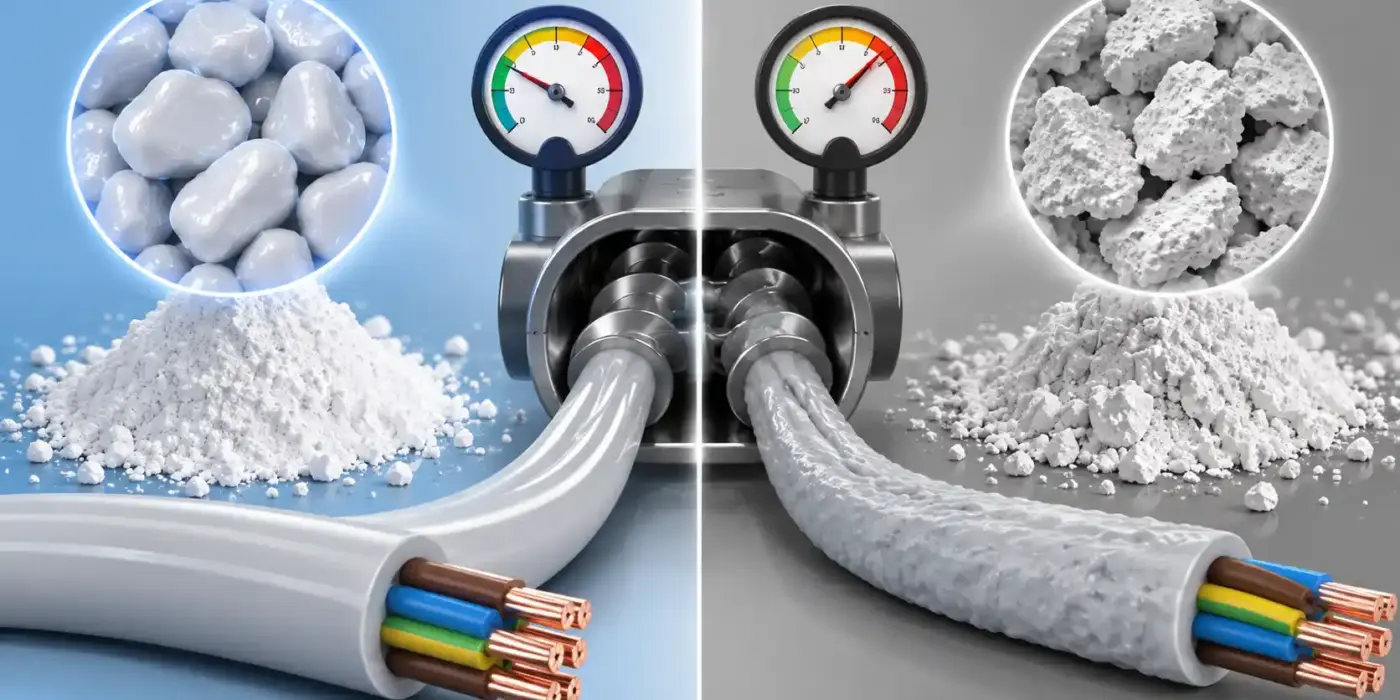
A purchase specification that says only “boehmite, AlOOH” can be chemically correct and still result in the wrong material for production. This happens most often when the process depends on acid peptization, gel formation, extrusion behaviour or a particular pore structure after calcination. A more crystalline boehmite and a highly dispersible pseudo boehmite may both be described as aluminium oxyhydroxide, but they do not necessarily behave the same once they enter the customer’s process.
The useful distinction between boehmite and pseudo boehmite is therefore not a different basic chemical formula. It is mainly a difference in crystal development, structural order and the processing properties that follow from that structure.
Table of Contents
They Can Share AlOOH Chemistry Without Behaving the Same
Boehmite is a crystalline aluminium oxyhydroxide commonly represented as AlOOH. Pseudo boehmite is also a boehmite-like aluminium oxyhydroxide, but the term is generally used for material with lower crystallinity, smaller coherent crystalline domains and a more disordered structure. It may also contain more physically associated or structural water than a well-crystallized boehmite.
The terminology is not perfectly uniform between suppliers, academic literature and industrial applications. This is one reason an RFQ based only on “boehmite” or “pseudo boehmite” can be ambiguous.
Pseudo boehmite should not be described as simply amorphous alumina, and lower crystallinity should not be confused with lower chemical purity. A high-purity pseudo boehmite can deliberately have a weakly crystalline, highly dispersible structure because that behaviour is required by the downstream process.
XRD Shows a Structural Difference, Not a Quality Ranking
The distinction can be seen by X-ray diffraction. A well-crystallized boehmite normally produces sharper and better-defined diffraction peaks, while pseudo boehmite commonly shows broader reflections associated with smaller crystalline domains and greater structural disorder.
This makes XRD useful when comparing two aluminium oxyhydroxide powders. It does not mean that the sample with sharper peaks is automatically the higher-quality material.
For a process that needs a stable crystalline boehmite, stronger crystal development may be desirable. For a catalyst binder that needs to disperse and peptize in acid, a less crystalline pseudo boehmite may be the more useful material.
Chemical purity and crystallinity should therefore be treated as separate specifications. A powder can have very low sodium, iron or silicon impurities while intentionally retaining the pseudo boehmite structure required for catalyst processing.
The Difference Becomes More Obvious During Peptization
Catalyst manufacturing is one of the clearest examples of why the distinction matters.
Suitable pseudo boehmite grades can be dispersed and peptized in acidic media to form a sol or gel-like binder phase. During extrusion or shaping, this behaviour helps the formulation develop the plasticity and green strength required before drying and calcination.
If the replacement material is substantially more crystalline or less dispersible, the same acid dosage may no longer produce the same result. Slurry viscosity can change, extrusion pressure can increase and the extrudate may lose shape retention or green strength even though the basic AlOOH analysis still looks acceptable.
This is why catalyst manufacturers often care about acid demand, peptization response and rheology as much as chemical assay.
The distinction should not be taken too far. It is not correct to say that every boehmite is impossible to peptize or that every pseudo boehmite disperses identically. Commercial grades differ in crystallinity, surface area, impurities, particle structure and manufacturing history. Peptization has to be tested under the actual acid concentration, pH, solids content and mixing conditions used by the customer.
For catalyst applications, Detopalu’s Pseudo Boehmite for Catalyst Carriers page covers the broader relationship between dispersibility, pore structure, impurity control and downstream catalyst production.
High BET Does Not Automatically Mean Better Pseudo Boehmite
Pseudo boehmite is often associated with high specific surface area and developed pore structure, particularly when it is used as a catalyst or activated-alumina precursor. These properties are important, but they are not the definition of pseudo boehmite.
Commercial grades can be produced with different BET surface areas, pore volumes, particle sizes and impurity levels depending on the intended process.
A higher BET value can be useful when the customer needs a highly accessible precursor. At the same time, more surface area can increase liquid demand and change slurry rheology. A catalyst extrusion process may therefore respond very differently to two powders even when both are sold as high-purity pseudo boehmite.
Pore volume should be treated in the same way. It is an important precursor property, but the final pore system after calcination also depends on shaping, additives, drying and the calcination profile.
The useful specification is not simply “highest BET available.” It is the BET and pore structure that produce the required process behaviour and final catalyst properties.
Calcination Does Not Make Every AlOOH Powder Equivalent
Both boehmite and pseudo boehmite can transform through transition-alumina phases during heating. This is one reason pseudo boehmite is widely used as an alumina precursor in catalyst manufacturing.
However, it is risky to assume that two different AlOOH powders will become equivalent simply because both are eventually calcined.
Their original crystallinity, pore structure, impurity profile and shaping behaviour can influence the material that remains after drying and calcination. Sodium and sulfate residues are particularly important in some catalyst systems, while the way the precursor was peptized and extruded can affect pore development and mechanical properties.
For this reason, precursor selection should start from the required final support and manufacturing route. The nominal AlOOH chemistry before calcination is only one part of that decision.
The Same Distinction Matters in Ceramics and Composite Systems
Peptization makes the difference between boehmite and pseudo boehmite particularly visible in catalyst production, but catalyst binders are not the only application.
In ceramic processing, purity, particle or agglomerate size, dispersion and thermal conversion may matter more than maximum acid peptizability. A ceramic producer may therefore evaluate an aluminium oxyhydroxide grade very differently from a catalyst extruder.
The Pseudo Boehmite for High-Performance Ceramics application page covers this use in more detail.
Coatings and composite formulations introduce another set of requirements. Dispersion stability, rheology and interaction with the liquid phase may become more important than the extrusion characteristics used to qualify a catalyst binder. Detopalu addresses these applications separately on the Pseudo Boehmite for Coatings and Composite Fillers page.
“Pseudo Boehmite” Alone Is Not Enough for an RFQ
For a catalyst customer, the required information may include peptization behaviour, acid demand, BET, pore volume and impurity limits. For extrusion, slurry viscosity, extrusion pressure and green strength can be more relevant than a single powder specification. Ceramic and coating customers will usually put different weight on particle size, dispersion and thermal behaviour.
| Process requirement | Properties worth confirming |
|---|---|
| Acid-peptized catalyst binder | Peptization, acid demand, pH response, slurry rheology |
| Porous catalyst support precursor | BET, pore volume, impurities, calcination response |
| Extruded catalyst or adsorbent | Plasticity, extrusion pressure, green strength, moisture |
| Ceramic precursor or binder | Purity, particle/agglomerate size, dispersion, thermal conversion |
| Coating or composite formulation | Dispersion stability, rheology, particle size, formulation compatibility |
Impurity limits also need to match the application. Sodium, iron, silicon, sulfate and chloride may all matter, but the acceptable level is determined by the downstream catalyst or manufacturing process rather than by a universal pseudo boehmite specification.
This avoids a common supplier comparison problem: two powders can both satisfy an AlOOH assay while giving very different production results because the purchasing specification never defined the property that controls the process.
Evaluating Detopalu Pseudo Boehmite
Detopalu’s Pseudo Boehmite Powder range is intended for applications where the behaviour of the aluminium oxyhydroxide precursor matters after it enters the customer’s formulation.
For catalyst production, provide the acid or peptization method, target slurry behaviour, required BET or pore range, impurity limits, forming method and any problem seen with the current material. If extrusion pressure is too high or green strength is insufficient, that information is more useful for grade comparison than AlOOH content alone.
For ceramic or coating applications, particle-size requirements, dispersion method, firing conditions or viscosity limits may become more important.