
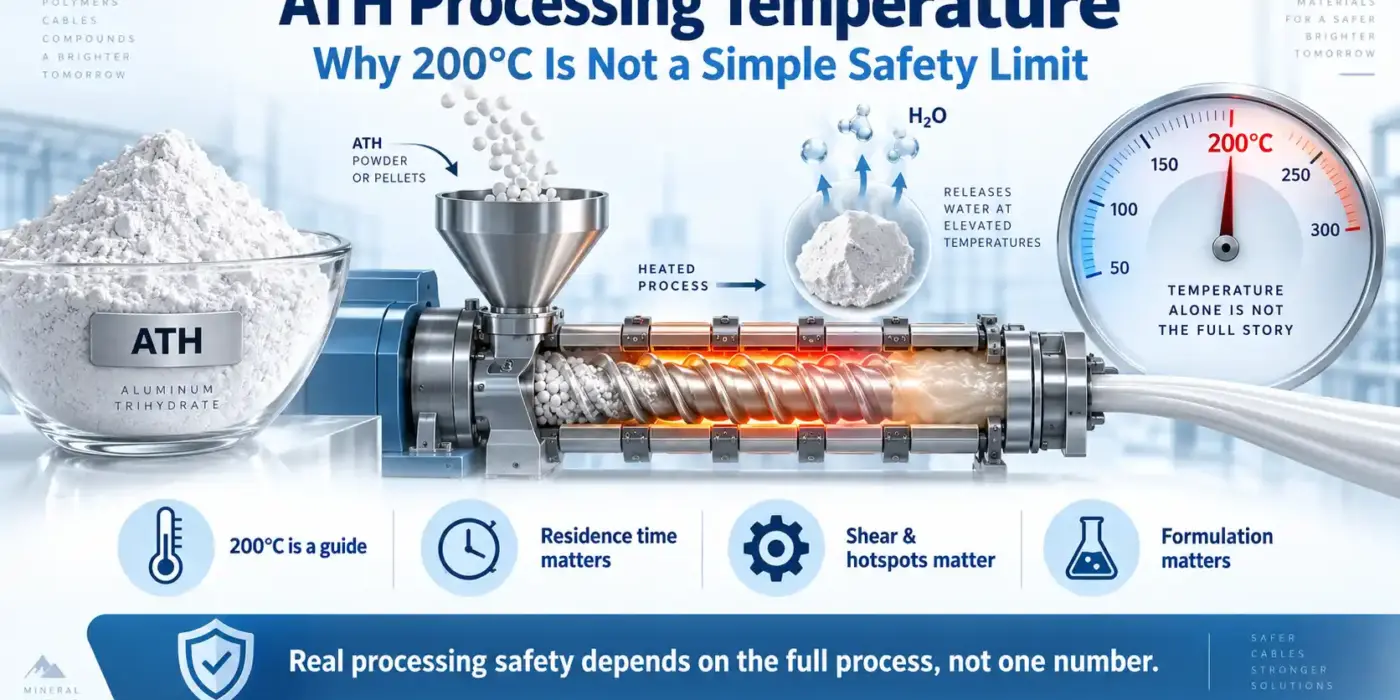
An ATH-filled cable compound may have barrel temperatures set below 200°C and still develop bubbles, rough extrusion or unstable pressure. Another compound may briefly approach the same temperature and run without an obvious problem.
The difference is that aluminium hydroxide does not experience the temperature shown on one machine controller. It experiences the actual melt temperature, local shear heating and the length of time the compound remains hot.
This distinction is important because ATH begins to release chemically bound water when it enters its decomposition range. If that happens during compounding or extrusion, part of the flame-retardant reaction has already started before the finished cable, rubber part or polymer component is produced.
Table of Contents
Why ATH Data Sheets Show Both 200°C and 220°C
Search for the decomposition temperature of aluminium hydroxide and two numbers appear frequently: approximately 200°C and approximately 220°C.
Both can be technically valid.
Nabaltec describes ATH as decomposing endothermically at approximately 200°C. Huber lists the decomposition temperature of ATH at approximately 220°C, while its cable-industry technical literature also states that ATH starts releasing water at about 200°C.
The difference should not be interpreted as one supplier being right and the other wrong. Thermal decomposition is measured under defined test conditions, and the reported temperature may represent the beginning of measurable water release, a characteristic point on a TGA curve or another defined thermal event. Heating rate, sample condition and measurement method can shift the reported value.
For polymer processing, the practical conclusion is straightforward: 220°C should not be treated as a guaranteed ATH processing limit.
Commercial guidance commonly recommends ATH for thermoplastic systems processed below approximately 200°C. The purpose is to maintain useful thermal margin before significant dehydration begins.
What Happens When ATH Starts to Decompose
Aluminium hydroxide releases water through an endothermic decomposition reaction:
2Al(OH)₃ → Al₂O₃ + 3H₂O
During a fire, this behaviour is useful. The reaction absorbs heat while the released water helps reduce the temperature of the burning polymer and contributes to flame and smoke suppression.
Inside an extruder, the same water release is unwanted.
ATH has a theoretical loss on ignition of roughly 34.6%, largely associated with the chemically bound water released during decomposition. A highly filled cable compound can contain a substantial amount of ATH, so even limited premature dehydration can introduce water vapour into the polymer melt.
Depending on the formulation and equipment, this can contribute to bubbles, internal voids, rough extrudate, pressure instability or surface defects.
These symptoms do not prove that ATH has decomposed. Wet polymer, residual moisture in the filler, volatile additives or poor venting can cause similar problems. The process history has to be examined before concluding that thermal decomposition is responsible.
Barrel Temperature Is Not the Same as Melt Temperature
Consider an extruder with several zones set around 175–190°C.
It may appear safely below the ATH decomposition region, but the polymer is also being heated mechanically. Screw rotation, kneading elements, back pressure and die resistance convert mechanical energy into heat.
This becomes more important in highly filled ATH compounds because their viscosity can be much higher than that of the unfilled polymer. More energy may be required to mix and move the compound, producing additional shear heating.
A machine showing a 185°C barrel temperature can therefore contain local regions where the compound itself is hotter.
This is why actual melt temperature is more useful than barrel settings when a formulation is operating close to the thermal limit. Where the equipment allows it, melt-temperature measurements should be considered together with screw torque, head pressure and throughput.
A stable barrel profile does not necessarily mean the compound is experiencing a stable thermal history.
Residence Time Can Change the Result Without Changing the Temperature Settings
Temperature is only part of the problem. Time matters as well.
ATH decomposition is not an instantaneous switch that changes completely at one temperature. A compound that briefly passes through a relatively hot region may behave differently from material held near that temperature for much longer.
This explains some production problems that appear without anyone changing the machine temperature profile.
For example, reducing line output can increase residence time. A restrictive screen or die can increase pressure and shear. A machine stop can leave compound sitting inside a hot barrel far longer than during normal production.
When production restarts, the first material leaving the line may therefore have experienced a very different thermal history from material produced during continuous operation.
If bubbles or surface defects occur mainly during start-up, low-output production or long residence, checking the ATH grade alone is unlikely to identify the whole problem.
Free Moisture and ATH Dehydration Are Not the Same Thing
This distinction is especially useful when investigating bubbles.
ATH powder can contain a small amount of free or adsorbed moisture. Polymer pellets and other formulation ingredients can also introduce water. Storage conditions, open bags and high ambient humidity may increase this problem.
Free moisture can often be addressed through better storage, material handling or suitable drying procedures.
Chemically bound water is different. It is part of the Al(OH)₃ structure and is released when ATH decomposes.
Drying the powder does not increase its fundamental decomposition temperature. Likewise, if ATH begins to dehydrate because the compound has been overheated, improving raw-material storage will not solve the thermal problem.
A useful troubleshooting comparison is therefore to change one condition at a time. If improved drying removes the bubbles while melt temperature remains unchanged, free moisture was probably involved. If defects repeatedly appear as actual melt temperature or residence time increases, ATH dehydration deserves more attention.
Polymer Type Is Only the Starting Point
ATH is widely used in EVA, polyethylene and many LSZH wire and cable compounds because these systems can often be processed within a suitable temperature range.
ATH can also be used in PVC, TPE, TPU, rubber and various thermoset formulations, but the polymer name alone does not determine whether the thermal window is suitable.
Two EVA compounds may behave very differently. Their vinyl acetate content, ATH loading, polymer viscosity, coupling system and extrusion rate can all differ. One formulation may run comfortably below the ATH dehydration region, while another reaches much higher melt temperature because of increased shear.
Polypropylene and many engineering thermoplastics present a more obvious problem because they often require higher processing temperatures. When the polymer process regularly approaches or exceeds the practical thermal range of ATH, changing ATH particle size is not a reliable way to solve the mismatch.
The flame-retardant chemistry itself needs to be reconsidered. This is where the ATH-versus-MDH decision discussed in the previous article becomes relevant.
There Is No Universal “Safe Margin”
It is tempting to create a simple purchasing rule such as:
ATH decomposes at 220°C, so processing at 200°C is safe.
That is too simple for production use.
There is also no universal rule stating that every ATH compound must remain exactly 10°C, 20°C or 30°C below a particular decomposition value. The required margin depends on the ATH grade, polymer viscosity, filler loading, screw configuration, throughput, residence time and how well actual melt temperature is controlled.
A better approach is to regard approximately 200°C as a region that requires closer attention for conventional ATH, rather than a target processing temperature.
If normal production stays comfortably below this region and melt temperature remains stable under different production conditions, ATH generally has more operating margin.
If the compound regularly approaches 200°C, qualification should include realistic production conditions rather than only a short laboratory extrusion trial.
Low throughput, high throughput, start-up, pressure changes and extended residence can all expose weaknesses that do not appear during an ideal test run.
If the Compound Starts Bubbling, Check the Process Before Changing ATH
When an established ATH-filled compound suddenly develops bubbles or rough extrusion, replacing the filler immediately can make troubleshooting more difficult.
First compare the problem run with a stable production run. Actual melt temperature, screw speed, torque, head pressure, output and residence time are more useful than the barrel temperature alone. Raw-material moisture should be checked separately so that free water is not confused with decomposition water.
If defects become worse as melt temperature or residence time increases, reducing the thermal load provides a useful confirmation test. If the problem remains when melt temperature is clearly below the critical region, attention should move toward moisture, dispersion, particle-size distribution, formulation additives or venting.
TGA can also be useful when comparing the thermal behaviour of different ATH materials, particularly when a formulation is close to its processing limit. Results should be compared using the same test method and conditions because decomposition temperatures from different laboratories are not automatically equivalent.
What Detopalu Needs to Know Before Recommending ATH
Detopalu supplies Aluminum Hydroxide Powder for flame-retardant and filler applications including wire and cable, rubber, plastics, epoxy and other polymer systems.
Current product specifications focus on properties such as Al(OH)₃ content, particle size, oil absorption, moisture, whiteness and impurity control. These are important for grade selection, but they do not describe the customer’s actual thermal processing conditions.
For a cable or polymer application, useful information should also include the polymer system, ATH loading, actual processing or melt temperature, current particle-size requirement and the production problem being observed.