
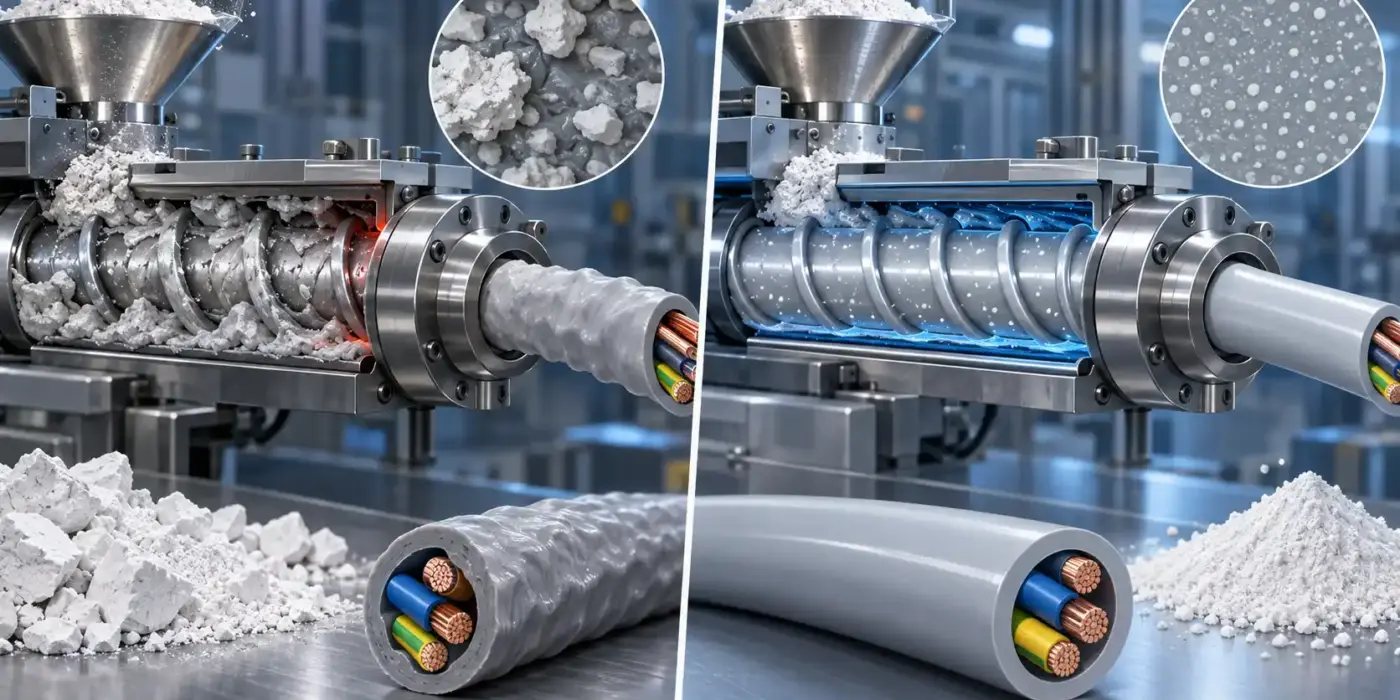
An LSZH cable compound can pass its flame requirement and still be difficult to manufacture. Mixer torque approaches the machine limit, die pressure rises, line speed has to be reduced and the finished sheath develops a rough or uneven surface. Because aluminium hydroxide is one of the largest components in many halogen-free flame-retardant formulations, the ATH is often blamed first.
Sometimes the powder is part of the problem. Sometimes changing the ATH only moves the problem somewhere else. High viscosity and poor surface quality can result from filler loading, particle-size distribution, agglomeration, filler–polymer compatibility, lubrication, moisture or excessive shear heating. The first task is therefore to identify what kind of extrusion defect is occurring before changing particle size or requesting a coated grade.
Table of Contents
High ATH Loading Changes the Rheology of the Whole Compound
ATH is not used like a low-dose processing additive. In LSZH formulations the mineral phase can account for a large part of the compound, so its physical properties directly affect how the polymer flows.
As ATH loading rises, less polymer is available to wet and separate the individual mineral particles. Particle–particle interaction becomes more important, while mixer torque, melt viscosity and extrusion pressure usually increase. This is the basic processing trade-off in highly filled flame-retardant compounds.
Reducing ATH loading will usually make extrusion easier, but it may also reduce the flame-retardant performance the formulation was designed to achieve. Before lowering the filler percentage, it is more useful to determine whether the existing ATH loading is being packed, dispersed and lubricated efficiently.
The Detopalu Aluminium Hydroxide for Wire and Cable Compounds application page covers the broader relationship between ATH grade selection, filler loading, dispersion and cable performance.
Read the Surface Defect Before Changing the ATH Grade
“Rough surface” is too broad to use as a diagnosis.
A uniform sharkskin-like texture is different from isolated pits. Small bubbles are different again. Each appearance points toward a different group of possible causes.
| Extrusion symptom | Check first |
|---|---|
| High torque but reasonably smooth surface | Filler loading, fines, BET, polymer viscosity, lubrication |
| Uniform rough / sharkskin surface | Die shear, extrusion rate, melt temperature, die condition |
| Random pits or hard points | Agglomerates, D90, coarse residue, contamination |
| Bubbles or small craters | Moisture, volatiles, venting, actual melt temperature |
| Torque and pressure rise during the run | Die build-up, screen restriction, thermal history, dispersion |
| Surface becomes worse at higher line speed | Wall shear, melt fracture, die geometry, lubrication |
This distinction prevents a common mistake. If coarse agglomerates are producing isolated surface defects, adding more lubricant will not remove them. If the entire surface becomes rough only as output increases, replacing ATH with a slightly finer grade may not correct excessive shear at the die.
The defect itself should determine the next experiment.
Particle Size Matters, but D50 Is Not Enough
When cable surface quality is poor, the immediate request is often for finer ATH.
That approach can work when genuinely coarse particles are the problem, but finer powder also increases the amount of mineral surface that has to be wetted by the polymer. At high filler loading, that can increase viscosity rather than reduce it.
ATH supplier data show that mean particle size is only one part of the rheology. Particle-size distribution, BET surface area and particle morphology also influence viscosity. A powder with an optimized distribution can sometimes pack more efficiently and produce lower viscosity than another ATH with a similar D50.
For a rough cable surface, D90 and coarse residue are particularly useful because they help describe the upper end of the distribution. For excessive viscosity, the fine fraction and BET deserve more attention.
Oil absorption adds another useful comparison. It is not a direct extrusion-viscosity test, but a powder with greater liquid demand may require more polymer or processing aid to wet its surface. The effect becomes more visible when the formulation is already highly filled.
Detopalu publishes D50, oil absorption, moisture and other base-powder parameters on the Aluminum Hydroxide Powder page. When troubleshooting an existing LSZH formulation, those values should be compared with the ATH batch that already runs successfully rather than choosing the smallest available particle size.
Poor Dispersion Can Look Like Excessive Viscosity
The same quantity of ATH behaves differently when it is properly distributed and when part of it remains in agglomerates.
Poor dispersion creates local regions with very high mineral concentration. These regions resist flow, raise mixing load and can later appear on the cable surface as hard points or irregular defects. A compound may therefore appear to have an ATH viscosity problem even though the real problem is how the powder is incorporated into the polymer.
Compare a stable batch with the problem batch before changing raw materials. Mixing sequence, feed rate, polymer lot, compatibilizer dosage, processing aid and mixing energy should all be checked. If the ATH COA is essentially unchanged but torque or surface quality shifts substantially, the investigation should not stop at the filler.
The filler–polymer interface can also contribute. A compatible surface treatment may improve wetting and change compound rheology, but coated ATH should not be treated as an automatic low-viscosity solution. The previous article, Coated vs. Untreated ATH: Why Lower Extrusion Torque Does Not Always Mean Better Cable Performance, explains why a lower torque result must still be checked against elongation, tensile performance and the curing system.
Lubrication Can Fix Friction but Not a Bad Powder Distribution
Highly filled LSZH compounds need an appropriate balance between internal and external lubrication.
Internal lubrication reduces friction within the compound and can improve the movement of polymer and filler during processing. External lubrication reduces friction between the melt and the screw, barrel or die surface.
When lubrication is insufficient, torque rises and the material may experience excessive shear near the die. The result can be reduced throughput, die build-up or a sharkskin-like surface.
The opposite approach—continually adding more wax or processing aid—can also create problems. Excessive lubrication may affect filler wetting, mechanical properties or surface behaviour. If progressively higher lubricant dosage is required to keep the same ATH grade running, the underlying PSD, dispersion and polymer compatibility should be reviewed.
This matters when comparing ATH suppliers. A powder that appears inexpensive per tonne but requires significantly more processing aid or forces a slower line speed may not be the lower-cost material in production.
Do Not Solve High Viscosity by Heating the Compound Indefinitely
Increasing extrusion temperature lowers polymer viscosity, so it is an obvious response when die pressure becomes too high.
ATH puts a limit on this approach.
Conventional aluminium hydroxide begins entering its dehydration region around 200–220°C. More importantly, the melt can be hotter than the barrel display because mechanical shear generates additional heat.
A line may therefore become easier to extrude after the temperature profile is raised while moving closer to a second problem: premature release of chemically bound water from ATH.
If that happens, bubbles, voids or pressure instability may appear even though the original viscosity problem has improved.
The relationship between barrel temperature, actual melt temperature and residence time is covered separately in ATH Processing Temperature: Why 200°C Is Not a Simple Safety Limit.
Moisture should be checked at the same time. Free moisture in ATH, polymer or additives can also produce bubbles and craters, but it is different from water released by ATH decomposition. If drying corrects the defect while processing temperature remains unchanged, free moisture was likely involved. If the problem follows higher melt temperature, higher shear or longer residence time, thermal history becomes more important.
Compare the Good Batch with the Bad Batch
One of the fastest ways to investigate an LSZH extrusion problem is to stop comparing the material only with the supplier’s TDS.
Compare it with the last batch that actually worked.
A formulation close to its maximum filler loading or torque limit can be sensitive to relatively small shifts in PSD, oil absorption, moisture or polymer viscosity. Values that remain technically “within specification” can still move the compound enough to affect extrusion.
Retaining reference samples from approved ATH batches is therefore useful for recurring cable production. When a problem appears, compare the new and approved materials using the same methods. PSD, D90, oil absorption, moisture and, where available, BET are more informative together than a single D50 value.
If the ATH data remain stable but the extrusion behaviour changes significantly, check the polymer resin, compatibilizer, lubricant package, screw condition and operating parameters.
If the powder characteristics move together with the production problem, a different ATH grade or tighter supply specification may be justified.
When ATH Is No Longer the Right Thermal Choice
Some processing problems cannot be solved by optimizing ATH.
If the polymer requires a melt temperature close to or above the practical thermal range of aluminium hydroxide, changing D50, coating or lubricant will not create a large new thermal window.
That situation belongs to a different material-selection decision.
The article ATH vs. Magnesium Hydroxide for Halogen-Free Flame Retardant Compounds explains why MDH becomes relevant when a polymer needs substantially higher processing temperatures.
For conventional EVA/PE LSZH systems that remain within an appropriate ATH processing range, the more useful questions are usually PSD, filler loading, wetting, rheology and batch consistency.
Detopalu’s Aluminium Hydroxide Flame Retardant Filler application page provides the broader selection context for cable, plastic and rubber flame-retardant systems.
What to Send When Asking an ATH Supplier to Troubleshoot the Compound
For Detopalu ATH evaluation, send the current formulation conditions together with the required flame, mechanical and extrusion targets. The objective is not to find the ATH with the lowest viscosity in isolation. It is to find a grade that can be processed consistently at the required loading while the finished LSZH cable continues to meet its full specification.