
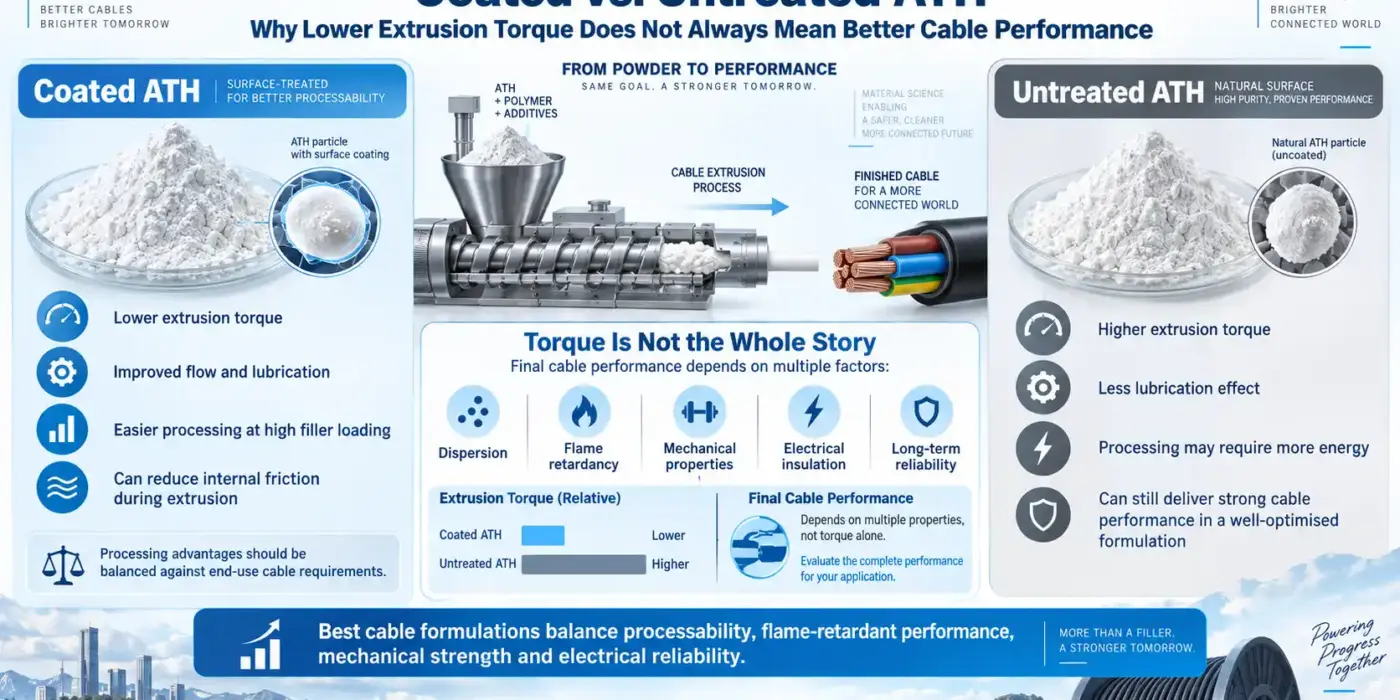
A cable compounder replaces an untreated aluminium hydroxide with a surface-treated ATH of similar particle size. The first extrusion trial looks promising: mixer torque falls, melt pressure is easier to control and the compound flows more smoothly. Then the finished cable is tested and elongation is lower than before.
A coated ATH changes the interaction between the mineral surface and the surrounding polymer. That can improve flow and dispersion, but it can also change filler–polymer adhesion, stiffness, curing behaviour and moisture resistance. The correct question is therefore not whether coated ATH is better than untreated ATH, but whether the treatment improves the property that is limiting the compound without damaging the properties that already meet specification.
Table of Contents
What Surface Treatment Actually Changes
Surface treatment does not change the fundamental flame-retardant chemistry of ATH. Aluminium hydroxide still decomposes endothermically and releases chemically bound water when exposed to sufficient heat.
The treatment acts mainly at the filler–polymer interface.
Untreated ATH has a polar, hydroxyl-rich surface. In highly filled EVA, polyethylene or rubber compounds, the polymer has to wet a large amount of mineral surface. If the interaction between the polymer and ATH is poor, the result may be higher compound viscosity, stronger particle–particle interaction or weaker stress transfer through the finished material.
A suitable surface treatment can modify this interface. Depending on the chemistry, it may improve wetting, reduce unwanted interaction between ATH particles or create stronger coupling with the polymer. This can make high filler loading easier to process, but the effect has to be evaluated in the complete formulation rather than from the powder specification alone.
“Silane-Treated ATH” Is Not a Complete Specification
Silane is a family of coupling agents, not one standard coating. Different silanes contain different functional groups, so their behaviour depends on the polymer, curing chemistry and treatment level.
Vinyl-functional treatments may be used in some grafted or cross-linked EVA and rubber systems. Amino-functional silanes can be useful in other polar or reactive formulations. Fatty-acid and other organic surface treatments may be selected where improved processing, lubrication or a more organophilic filler surface is required.
These are not fixed rules. The suitability of a treatment depends on the actual formulation, including polymer chemistry, EVA vinyl-acetate content, peroxide system, grafting or cross-linking route, processing temperature and dosage.
For this reason, a specification such as “ATH, D50 2 μm, silane treated” is still incomplete. The compounder should know what the treatment is intended to do and which type of polymer system it was developed for.
Why Torque Can Improve While Elongation Gets Worse
Consider an EVA-based LSZH cable compound with a high ATH loading. The untreated filler gives acceptable flame performance and mechanical properties, but mixer torque and extrusion pressure are too high.
A treated ATH may improve wetting and reduce filler–filler interaction. The compound then flows more easily through the mixer and extruder, which explains the lower torque.
At the same time, however, the treatment can change how strongly the ATH is bonded to the polymer or how the curing system behaves. Stronger interfacial adhesion can increase stiffness, while some treatment chemistries may influence cross-linking. The finished compound can therefore show better processing but lower elongation.
This is particularly important in cable applications because flexibility cannot be treated as a secondary property. A material that runs faster through the extruder but no longer meets elongation or ageing requirements is not an improvement.
More Surface Treatment Is Not Necessarily Better
Surface treatment also has an optimum level.
Too little treatment may provide limited coverage of the ATH surface. An appropriate level can improve wetting or interfacial behaviour. Excessive treatment may change lubrication, cure response or mechanical properties without producing a corresponding processing benefit.
This is one reason two suppliers can both offer “silane-treated ATH” and obtain very different results in the same compound. The treatment chemistry may be different, the treatment level may be different, or both.
For production qualification, consistency matters as much as the initial laboratory result. A supplier does not necessarily need to disclose a proprietary coating formula, but the treatment process should be controlled from batch to batch.
Are You Testing the Coating or the Powder?
This is often the more important question.
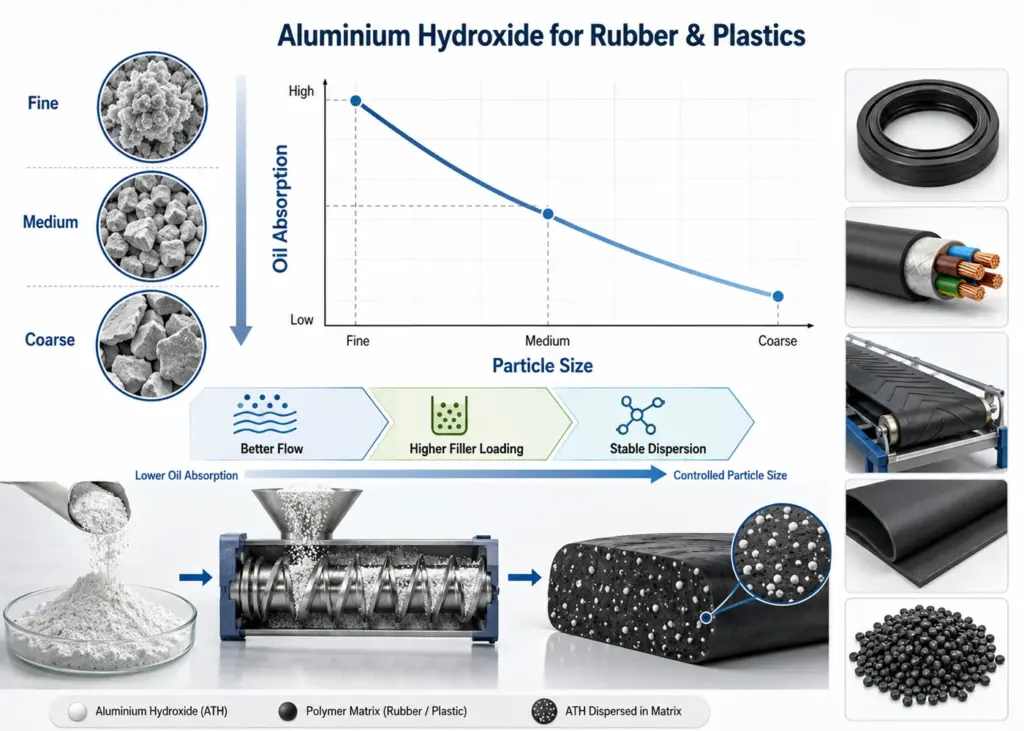
Suppose the existing ATH is untreated with a relatively fine particle size and higher oil absorption. The replacement material is surface treated, slightly coarser and has lower oil absorption. The second material produces lower viscosity.
It is tempting to attribute the whole improvement to the coating.
But several variables changed at the same time.
A coarser ATH generally presents less total surface area to the polymer than a finer powder. A different particle-size distribution changes filler packing. Lower oil absorption can also indicate a powder that requires less resin for wetting. These effects can reduce viscosity even before surface treatment is considered.
Two ATH products should therefore not be described simply as “treated versus untreated” when their physical powder properties are also substantially different.
For example, Detopalu currently publishes different specifications for H-WF-5LV and H-WF-8LV. H-WF-5LV has a listed D50 of 5–8 μm and oil absorption of ≤30 ml/100 g, while H-WF-8LV has a D50 of 7–9 μm and oil absorption of ≤25 ml/100 g.
Those differences alone can influence compound behaviour.
If a future coated grade is compared with one of these untreated materials, particle size and oil absorption should be considered before the processing improvement is attributed to the coating.
Compare Materials Against the Production Problem
A good qualification trial starts with the problem the compounder is trying to solve.
If extrusion pressure is too high, then pressure, output and compound flow should improve. If elongation is the limiting property, the trial has to demonstrate an improvement in elongation without losing flame performance. If moisture resistance is the reason for changing ATH, water-immersion or relevant electrical tests become more important than a small reduction in mixer torque.
| Current problem | What should be checked |
|---|---|
| High mixing torque | Torque, viscosity, processing stability |
| High extrusion pressure | Melt pressure, throughput, surface quality |
| Poor dispersion | Agglomerates and finished surface |
| Low elongation | Elongation, tensile strength and modulus |
| Moisture-related problems | Water uptake and relevant electrical performance |
| Flame performance below target | Required flame test at the same ATH loading |
The new ATH should improve the problem being targeted while maintaining the properties that already pass.
That sounds obvious, but it prevents a common raw-material qualification mistake: approving a new powder because one laboratory number improved while the actual production requirement was never tested.
Untreated ATH Is Often the Correct Choice
Untreated ATH should not be treated as the lower-grade option.
If an existing material reaches the required filler loading, processes consistently and meets the required mechanical, electrical and flame performance, there may be no reason to add another surface treatment.
Some compounders also prefer to control the interface themselves. Their formulation may already contain silane, compatibiliser, processing aid or a specific cross-linking package. Introducing a pretreated ATH can change that established balance.
In these systems, untreated ATH provides a predictable base material and allows the compounder to control coupling chemistry directly.
It is also the best reference when evaluating a treated material. Without an untreated control with comparable powder properties, it becomes difficult to determine what the coating actually changed.
How to Compare Treated and Untreated ATH Properly
If the purpose of a trial is specifically to evaluate surface treatment, keep the other variables as close as possible. The two materials should ideally have similar particle-size distribution, base-powder chemistry, moisture and oil absorption, while ATH loading, polymer batch, additive package and processing conditions remain unchanged.
This creates a much cleaner comparison.
If the two powders cannot be matched this closely, the trial is still useful. It simply answers a different question: which complete ATH grade works better in the formulation?
That is not the same as proving that the coating itself caused the difference.
What Should Be Confirmed Before Buying Coated ATH?
The normal ATH specification still matters after surface treatment. Al(OH)₃ content, impurities, particle-size distribution, moisture, oil absorption and batch consistency remain important.
The surface treatment adds another group of questions. The buyer should understand the treatment family, the polymer system it was developed for and whether the treatment is suitable for the intended curing or cross-linking system.
The exact proprietary coating formula does not always need to be disclosed. But descriptions such as “surface treated” or “suitable for polymers” are too general for a high-loading cable compound.
Before changing materials, the supplier and compounder should be discussing the same formulation problem.
Evaluating Detopalu ATH for Cable Compounds
Detopalu’s current Aluminum Hydroxide Powder range publishes base-powder information including Al(OH)₃ content, particle size, oil absorption, whiteness, moisture and impurity limits.
The currently published specifications do not identify a standard silane, fatty-acid or other surface-treatment chemistry for each listed grade. A model suffix should therefore not be interpreted as proof of a specific coating unless the treatment has been confirmed separately.
For a meaningful ATH evaluation, start with the current compound rather than asking which coating is best. The useful information is the polymer system, ATH loading, current particle-size specification, processing temperature, curing or cross-linking system, and the property that is causing the production problem.
If the current limitation is excessive torque, poor dispersion, low elongation or moisture resistance, a suitable surface treatment may be worth testing.
If the real problem is particle-size distribution, excessive fines, moisture, filler packing or processing temperature, changing the coating may only change the symptom rather than solve the cause.