
A cable compound running smoothly at 175°C may work well with aluminium hydroxide. Move the same flame-retardant concept into a polypropylene compound processed above 200°C and the result can be completely different.
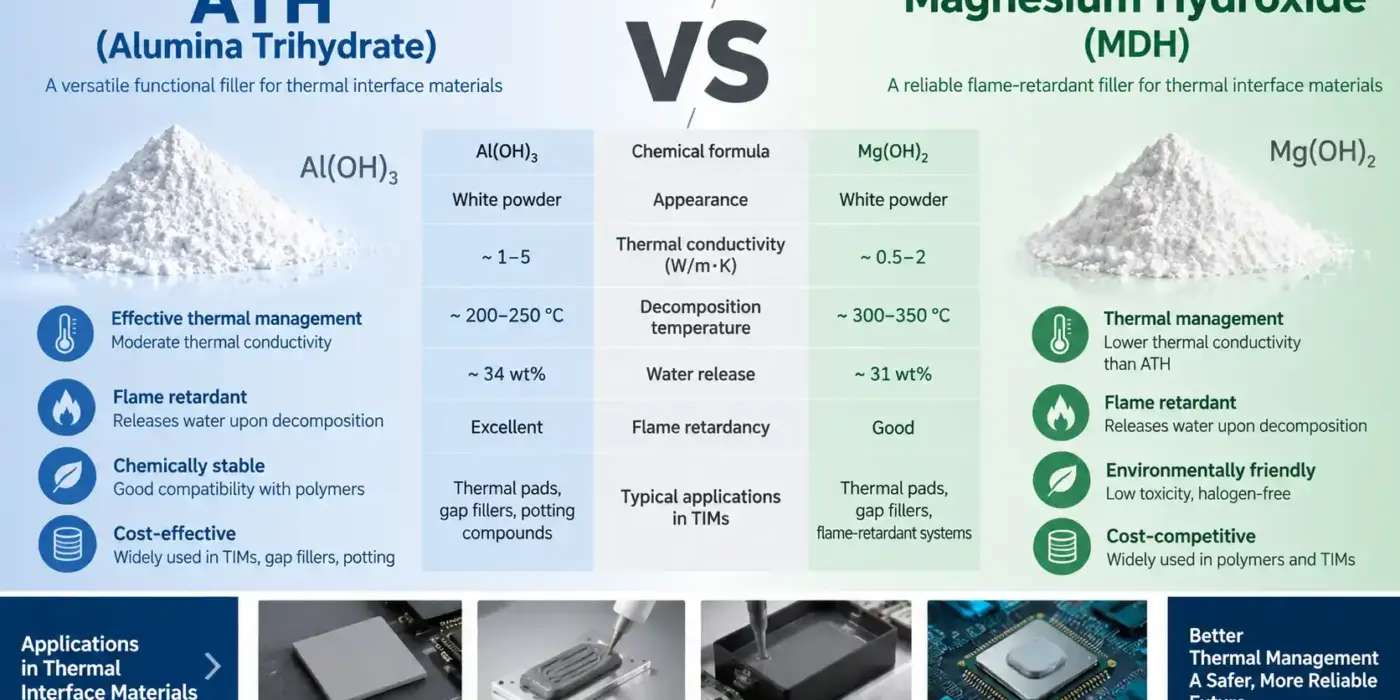
The problem is temperature. Aluminium hydroxide, usually referred to as ATH, begins its endothermic decomposition at roughly 220°C. Magnesium hydroxide, or MDH, remains stable to considerably higher temperatures and decomposes at roughly 330°C.
That difference determines where each material can realistically be used.
For compounders, ATH versus MDH is therefore primarily a processing-window decision before it becomes a flame-retardant performance decision.
Table of Contents
Start with the hottest part of the process
A polymer data sheet might recommend processing at 180°C, but the set temperature on the extruder is not necessarily the highest temperature experienced by the compound.
Shear in the screw, residence time and local hot spots can push the actual melt temperature higher.
That matters with ATH.
If aluminium hydroxide starts releasing chemically bound water inside the extruder, the compound may show unstable pressure, porosity, poor surface appearance or inconsistent extrusion. The ATH has already started doing the job it was supposed to perform during a fire—only now it is happening during manufacturing.
This is why a compound processed close to ATH’s decomposition region needs more attention than simply checking the nominal barrel temperature.
For an EVA or polyethylene LSZH cable compound operating with a comfortable thermal margin, ATH remains a very practical option.
For a polymer that needs substantially higher processing temperatures, MDH becomes more attractive because it provides more thermal headroom.
The first comparison can therefore be kept simple.
| Processing situation | Starting direction |
|---|---|
| EVA / PE LSZH compound at moderate temperature | ATH |
| Flexible PVC or many rubber systems | ATH |
| Polyester, epoxy and other lower-temperature thermosets | ATH |
| Processing temperature approaching ATH decomposition | Recheck ATH thermal margin |
| Higher-temperature PP formulation | MDH deserves evaluation |
| PA and other high-temperature engineering plastics | MDH or another high-temperature FR system |
This is a starting point, not a formulation recipe. Polymer grade, residence time and actual melt temperature still need to be considered.
Why ATH remains so widely used
If MDH tolerates more heat, it may seem logical to use MDH everywhere.
That usually misses the real formulation problem.
Many flame-retardant polymers simply do not require a 300°C-plus processing window. In EVA, PE, rubber, epoxy, polyester and numerous other systems, ATH already operates within an appropriate thermal range.
MDH solves a different problem
When a polymer requires melt processing above the comfortable range for aluminium hydroxide, MDH allows the compounder to retain the metal-hydroxide flame-retardant mechanism at a higher processing temperature.
Its decomposition can be represented simply as:
Mg(OH)₂ → MgO + H₂O
Like ATH, the reaction consumes heat and releases water.
The important difference is when it happens.
This makes MDH relevant for higher-temperature thermoplastics where ATH could begin decomposing during compounding.
High filler loading changes the material itself
It is useful to stop thinking of ATH and MDH as conventional low-dose additives. In many halogen-free flame-retardant systems, they are used at high loading levels and become a major part of the compound, meaning their physical properties can directly affect manufacturing.
Changes in particle size, surface treatment, moisture content, or particle distribution can influence viscosity, polymer adhesion, processing stability, and packing. As a result, two batches may meet the same basic chemical specifications yet behave differently during processing.
For manufacturers purchasing ATH or MDH in volume, batch consistency is therefore just as important as headline purity.
Particle Size Has to Match the Compound
Smaller ATH particles are sometimes marketed as inherently better because they provide greater surface area. But it is not that simple.
Fine particles can improve dispersion and surface quality in some systems, but their higher surface area can also increase viscosity at high loadings. Coarser particles reduce total surface area, but may create other issues if the particle-size distribution is not suitable for the finished product.
The useful specification is therefore not the smallest available D50. It is a particle-size distribution that matches the required filler loading while maintaining stable extrusion and consistent mechanical properties.
For this reason, compounders evaluating a new ATH supplier should retain the particle-size data from the approved production sample. Future batches can then be compared against a proven reference rather than an arbitrary micron value.
Surface Treatment Becomes Important at High Loading
Untreated aluminum hydroxide has a hydrophilic mineral surface, while many cable and polymer matrices are comparatively hydrophobic.
At low filler concentrations, this difference may be manageable. At very high loadings, however, the filler–polymer interface becomes much more important.
A suitable surface treatment can improve compatibility between ATH and the resin system, influencing dispersion, processing viscosity, and mechanical properties.
But there is no universal “treated ATH” that is automatically superior. The surface chemistry needs to match the polymer system.
An ATH developed for an EVA-based cable compound should not automatically be expected to perform the same way in epoxy, polyester, rubber, or another thermoplastic.
That is why the more useful purchasing question is not:
Is this ATH coated?
It is:
What is the surface treatment, and which polymer system was it developed for?
Where ATH Makes Sense—and Where It Stops Making Sense
For Detopalu customers, this distinction is particularly relevant because the current product range is focused on aluminum hydroxide rather than magnesium hydroxide.
ATH is a logical material to evaluate for applications such as LSZH cable compounds, rubber materials, epoxy insulation, coatings, fire-resistant boards, and thermoset composites, provided the processing temperature is within an appropriate range.
If a customer’s polymer must routinely be compounded at temperatures that leave too little safety margin before ATH begins to decompose, this should be identified before recommending an ATH grade.
Selling a finer ATH powder does not solve a fundamental temperature mismatch. In such cases, a different flame-retardant system may be required.
This boundary is useful commercially as well as technically. It helps avoid spending weeks adjusting particle size or surface treatment for a formulation in which ATH was thermally unsuitable from the beginning.
What Information Actually Helps Select an ATH Grade
For example:
EVA-based LSZH cable compound
Melt temperature: 175–185°C
ATH loading: 60 wt%
Current D50: 2 μm
Problem: high extrusion torque and low elongation
Required flame test: specified cable standard
That information immediately changes the discussion.
The processing temperature suggests that ATH is still a reasonable flame-retardant chemistry. The problem is more likely to involve grade selection or formulation.
Particle size, PSD, oil absorption, surface treatment, and filler loading can then be compared against the currently approved material.
Contrast that with:
PP compound
Actual melt temperature: 230°C
Looking for aluminum hydroxide flame retardant
Here, adjusting the ATH particle size is not the first task.
The processing temperature has to be addressed first.
ATH or MDH?
The decision can be reduced to two different problems.
If the polymer is processed within a suitable temperature range for aluminium hydroxide, there is little value in changing chemistry before the ATH grade and formulation have been properly optimised.
For these systems, focus on particle size, loading, surface treatment, dispersion and mechanical properties.
If the polymer requires a processing temperature too close to or above ATH’s practical thermal window, improving ATH dispersion will not remove that limitation.
That is where MDH becomes relevant.
ATH and MDH are not simply two competing flame-retardant powders. They occupy different processing windows.
Once the correct hydroxide chemistry has been chosen, the real formulation work starts.
Detopalu supplies Aluminum Hydroxide Powder for flame-retardant and industrial filler applications. For grade evaluation, provide the polymer type, actual melt temperature, current ATH loading, existing particle-size specification and the problem observed during compounding or extrusion.